Introduction
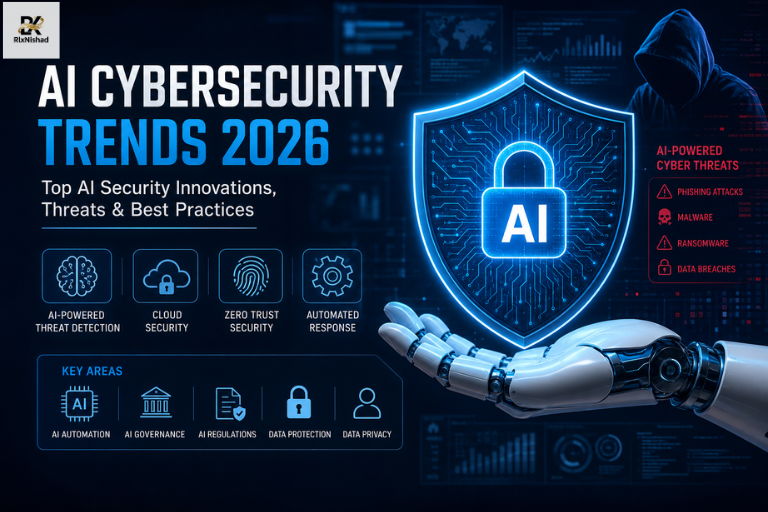
As organizations continue their digital transformation journey, the role of AI cybersecurity has become more critical than ever. In 2026, businesses are investing heavily in artificial intelligence to strengthen their cyber defenses while cybercriminals are also leveraging advanced AI technologies to launch sophisticated attacks. This evolving landscape has made AI in cybersecurity one of the fastest-growing technology trends.
From cloud security and network security to data protection and threat hunting, AI is transforming how organizations detect, prevent, and respond to cyber threats. However, with the rise of generative AI, autonomous AI, and deep learning, new security risks have also emerged. This article explores the latest AI security innovations, emerging threats, and best practices that businesses should follow in 2026.
Why AI Cybersecurity Matters in 2026
Modern cyberattacks are becoming more intelligent, automated, and difficult to detect. Traditional security systems often struggle to identify advanced threats before damage occurs. This is where AI cybersecurity offers a significant advantage.
Using machine learning, deep learning, and intelligent analytics, AI systems can process millions of security events every second. They identify unusual behavior, detect malware, and respond to attacks much faster than traditional security tools.
Organizations across industries are integrating AI security into their existing cybersecurity infrastructure to reduce response time, improve operational efficiency, and strengthen overall cyber resilience.
Top AI Security Innovations in 2026
1. AI-Powered Cybersecurity Solutions
Modern AI powered cybersecurity solutions use predictive analytics and automation to identify vulnerabilities before attackers exploit them. These systems continuously monitor networks, applications, and endpoints while learning from new attack patterns.
Businesses adopting AI-driven security platforms experience faster incident detection, lower operational costs, and improved protection against evolving threats.
2. Autonomous AI for Security Operations
The rise of autonomous AI is revolutionizing cybersecurity operations. Instead of waiting for human intervention, autonomous systems can investigate suspicious activities, isolate infected devices, block malicious traffic, and initiate incident response automatically.
Security teams can now focus on strategic planning while AI handles repetitive monitoring tasks.
3. Zero Trust Security
One of the biggest cybersecurity trends is the adoption of zero trust security. This approach assumes that no user or device should be trusted automatically.
AI continuously verifies user identity, analyzes device behavior, and monitors network activity to ensure only authorized users gain access to critical resources.
4. Cloud Infrastructure Security
As organizations migrate workloads to the cloud, cloud infrastructure security has become a top priority. AI helps monitor cloud environments, identify configuration errors, detect unauthorized access, and prevent data leaks.
Combined with modern cloud security solutions, AI significantly improves visibility across hybrid and multi-cloud environments.
AI Is Also Empowering Cybercriminals
While AI strengthens cyber defense, it also gives attackers more sophisticated tools.
Today’s cybercrime groups use AI to automate phishing campaigns, create convincing fake identities, generate malicious code, and discover software vulnerabilities faster than ever before.
The rapid growth of generative AI enables attackers to create realistic emails, fake voice messages, and highly personalized social engineering attacks that are difficult to identify.
Organizations must understand that AI is both a powerful defensive technology and a potential weapon in the hands of cybercriminals.
AI in Cybersecurity: Protecting Critical Data
Protecting sensitive information remains one of the biggest challenges for businesses.
AI improves data protection by monitoring file access, identifying abnormal data transfers, and preventing insider threats. Intelligent systems can immediately alert administrators when confidential information is accessed unusually.
At the same time, organizations must prioritize data privacy by ensuring AI systems comply with local and international regulations. Responsible AI deployment helps maintain customer trust while reducing legal and compliance risks.
AI Governance and AI Regulations
As AI adoption accelerates, effective AI governance is becoming essential.
Organizations need clear policies for AI development, deployment, monitoring, and accountability. Governance frameworks help reduce bias, improve transparency, and ensure responsible decision-making.
Governments worldwide are also introducing new AI regulations to improve security, protect consumer rights, and establish standards for trustworthy AI systems.
Businesses that proactively implement governance practices will be better prepared for future compliance requirements.
AI Enhancing Network Security
Modern enterprises operate across distributed networks, making network security increasingly complex.
AI analyzes billions of network events to detect suspicious activity, identify lateral movement, and stop attacks before they spread. Intelligent monitoring significantly reduces false positives while improving detection accuracy.
Security teams also use AI for advanced threat hunting, proactively searching for hidden threats that traditional security tools might overlook.
Digital Transformation Requires Intelligent Security
Successful digital transformation depends on secure technology adoption.
Whether organizations implement cloud computing, IoT devices, remote work environments, or AI-powered business applications, cybersecurity must remain a strategic priority.
AI enables businesses to secure modern infrastructures without slowing innovation, making cybersecurity an essential pillar of digital transformation initiatives.
Ethical Hacking Meets Artificial Intelligence
Security professionals are increasingly combining AI with ethical hacking techniques.
AI-powered penetration testing tools identify vulnerabilities more efficiently, simulate attack scenarios, and recommend security improvements. This proactive approach allows organizations to strengthen defenses before attackers discover weaknesses.
Ethical hackers supported by AI can assess complex infrastructures faster than traditional manual testing methods.
Best Practices for AI Cybersecurity in 2026
Organizations should adopt the following best practices:
- Deploy trusted AI cybersecurity platforms with continuous monitoring.
- Strengthen cloud security using automated AI analytics.
- Implement zero trust security across users, devices, and applications.
- Invest in employee awareness training against AI-generated phishing attacks.
- Build strong AI governance policies.
- Stay compliant with emerging AI regulations.
- Protect sensitive information using advanced data protection technologies.
- Conduct continuous threat hunting using AI-powered analytics.
- Perform regular ethical hacking assessments.
- Continuously update cybersecurity strategies to address evolving cybercrime tactics.
Conclusion
The future of AI cybersecurity is both exciting and challenging. Innovations in artificial intelligence, machine learning, deep learning, and generative AI are helping organizations build stronger cyber defenses while simultaneously creating new opportunities for cybercriminals.
Businesses that invest in AI security, cloud infrastructure security, network security, and responsible AI governance will be better positioned to defend against emerging threats. By combining AI-powered cybersecurity solutions with zero trust security, data privacy, ethical hacking, and continuous threat hunting, organizations can create resilient security strategies that protect critical assets throughout 2026 and beyond.