Introduction
Building a business followed a straightforward and predictable logic for decades.
More workers were needed to generate more income. Coordination increased with the number of participants. Organizational drag was caused by increased coordination. By amassing labor, scale was attained.
Quietly, that presumption is being violated.
The Number That Changes Everything
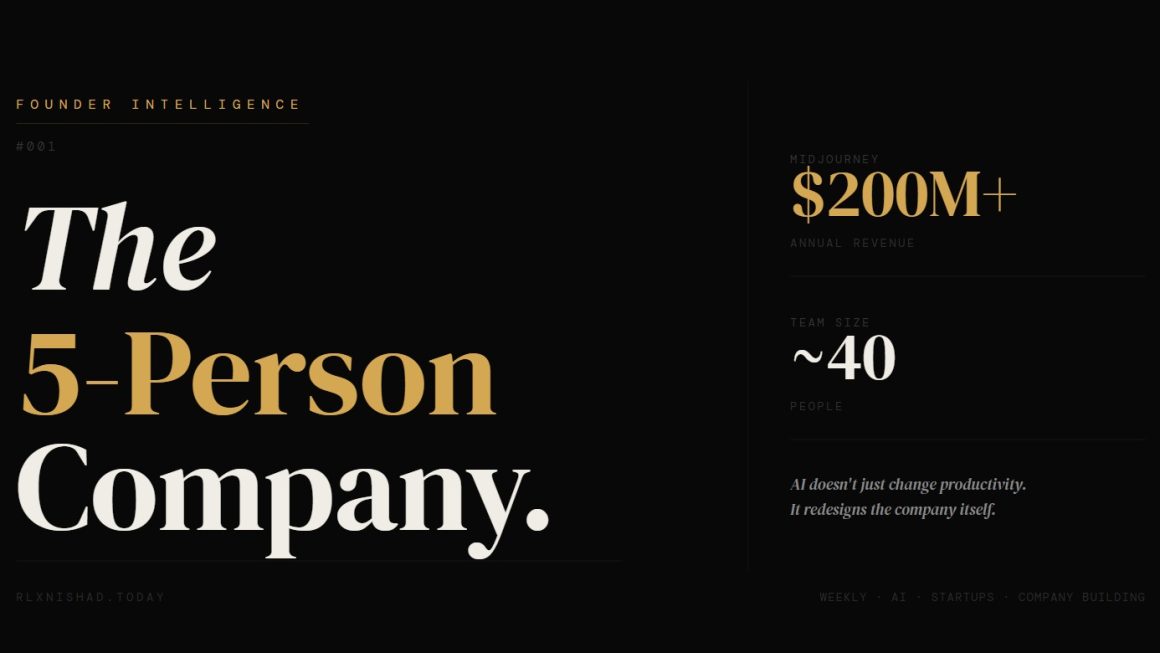
With about 40 employees, Midjourney reportedly generated more than $200 million in sales annually.
Not 400. Not four thousand. Forty.
That translates to more over $5 million in revenue per person, a ratio that ten years ago would have been unthinkable for a large business. Furthermore, Midjourney is not by itself. Teams that were once thought to be too tiny to function at that level are now producing substantial revenue for an increasing number of businesses.
It’s not about putting in more effort. Finding exceptionally gifted individuals is not the goal. It has to do with something more structural.
What Actually Changed
AI modifies a company’s economic structure.
Operational capabilities that once needed entire departments can now be deployed by a small team. Once requiring a group of writers, editors, and managers, content systems now only require one person and a series of carefully crafted prompts. Software has made it possible to scale customer service, which formerly required a floor of humans. It now takes hours to do research that used to take weeks. Internal processes that once required a specialized workforce now operate autonomously in the background.
Software is increasingly used to scale functions that were previously handled by hiring.
As a result, a whole different kind of business is created, one in which output can rise but staff remains essentially unchanged.
The Old Logic vs. The New Logic
This is how the industrial model of business building appeared:
Increased ambition leads to increased revenue targets, hiring, management, coordination costs, and organizational drag.
Mass was the result of growth. Complexity was a result of mass. Slowness was a result of complexity.
The new model appears differently:
Lean execution, improved systems, software-enabled processes, increased ambition, and reinvestment in product and distribution.
The same accumulation of individuals is no longer necessary for growth. System design is becoming the bottleneck instead of labor.
What This Rewrites
Efficiency measurements are not the only ramifications. Everything downstream changes when businesses need fewer workers to make a substantial profit.
Capital efficiency shifts. A startup may now require a quarter of the $10 million it historically needed to hire the workforce needed to generate $5 million in sales. Funding and output no longer have a linear connection.
Organizational design modifications. When a team is tiny by design, the management layers that were in place to manage large teams become superfluous. The flattening of the organizational chart is a structural reality rather than a cultural decision.
The dynamics of venture investment change. The conventional venture model big checks in exchange for hypergrowth headcount comes under attack if businesses can achieve meaningful scaling with smaller staff and less funding. Renegotiating the criteria of what constitutes a fundable company is underway.
Defensibility shifts from labor scale to system leverage. How many people you have is no longer the moat. It’s the quality of your systems, the extent to which your operations are automated, and the speed at which you can redeploy capacity in response to changes in the market.
Smaller in Mass, Not in Ambition
By default, the modern startup is getting smaller structurally.
It is not smaller than what it seeks to construct. The issues it seeks to resolve are not less significant. less operational mass, or the quantity of personnel, layers, and coordination expenses needed to perform at a high level.
Compared to today’s mid-sized businesses, the next generation of huge corporations might have fewer employees. That is neither a market anomaly nor a transient AI trend. It is a radical overhaul of how businesses are established, run, and expanded.
Founders who grasp this early on will construct in a different way. They will treat software as organizational infrastructure rather than a tool, hire later, and standardize earlier.
The ones who miss it will build the old manner – and wonder why they feel heavy.